
Should Aussie CEOs Outsource? How Top Leaders Outsource to Focus on Growth

As a CEO who's running a small business in Australia, you most likely have many compelling reasons to outsource. Perhaps to access specialised skills, control your operating costs, or to give yourself and your internal teams more time to focus on growth.
Yet, despite the numerous benefits it brings to the table, most are hesitant to proceed for fear of not knowing how to get started with outsourcing.
According to ResearchGate's survey examining micro-business delegation habits, 79.2% of respondents indicated they would only consider outsourcing non-essential services once their business grew larger.
Key Takeaways
- Overcome Local Shortages: Access global talent pools as Australian job fill rates drop to 68.2%.
- Reduce Operating Costs: Outsource specialised functions to lower labor costs while maintaining quality standards.
- Systematise with SOPs: Standardise workflows with documented SOPs and clear KPIs to ensure seamless execution.
Australia’s Skill Shortage Deepens as Job Fill Rate Drops to 68.2% in 2026
Australia’s hiring market remains challenging, with employers filling only 68.2% of advertised vacancies in the March quarter of 2026, as reported by Jobs and Skills Australia (JSA) in their Occupation Shortage Report (March Quarter 2026). The rate fell from 69.1% in the December quarter and was 3.3 percentage points lower than a year earlier.
The pressure is often greater outside major metropolitan areas. Regional employers continue to face smaller candidate pools and more difficulty attracting qualified workers, creating delays in recruitment and additional pressure on existing employees.
Should Aussie CEOs Outsource? Start With This 5-Step Workflow
If you’re thinking about beginning the outsourcing process, use the following workflow to determine what to delegate and how to manage it:
Step 1: Decide Tasks to Outsource
To maximise return on investment (ROI), categorise your company’s workload using a simple Task Allocation Matrix:
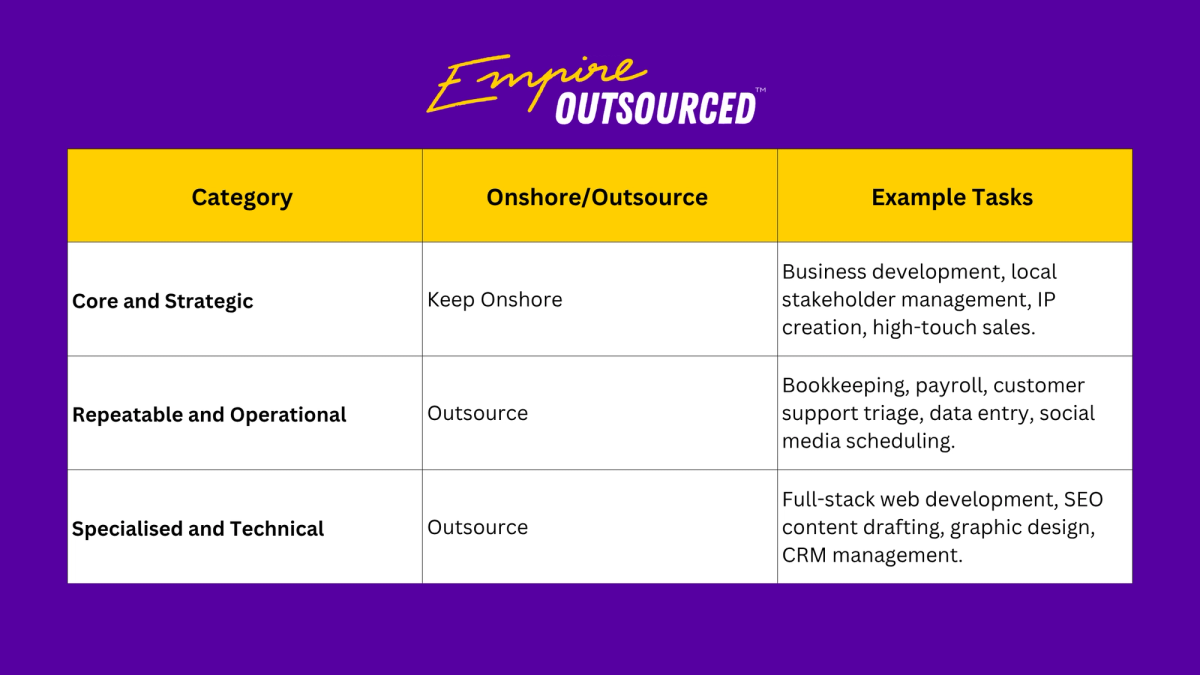
If a task takes more than 3 hours a week, follows a clear set of rules, and does not require physical presence in Australia, it should be queued for outsourcing.
Unsure which positions to delegate first? Check out our guide on the six roles Australian SMEs should outsource in 2026!
Step 2: Define the Role or Project
Ambiguity is the single biggest cause of failed outsourcing initiatives. Clearly define scope and expectations prior to recruitment:
- Draft Standard Operating Procedures (SOPs): Create step-by-step Loom walkthroughs or written manuals outlining expected inputs, tools, and outputs.
- Establish Key Performance Indicators (KPIs): Define measurable benchmarks (e.g., "Resolve 90% of tier-1 support tickets within 15 minutes" or "Reconcile daily accounts by 5:00 PM AEST").
- Determine Work Hours and Shift Alignment: Decide whether the role requires real-time Australian business hours (AEST/AWST overlapping) or asynchronous coverage (e.g., overnight processing).
When you hire a virtual assistant, creating SOP documents can help make sure that all the tasks are delegated with clarity and uniformity, which reduces the need for constant supervision.
Step 3: Evaluate Candidates
When vetting candidates or outsourcing and talent-matching agencies like Empire Outsourced, prioritise practical evaluation over resume scanning:
- Conduct Paid Skills Tests: Assign a short, real-world scenario or mini-project (e.g., drafting a sample blog outline or troubleshooting a mock code bug) to test technical accuracy under deadline constraints.
- Assess English and Communication Nuance: Ensure the candidate understands Australian business culture, communication tone, and active listening skills.
- Check Security and Infrastructure: Verify if the candidates have reliable high-speed internet, secure equipment, updated anti-virus software, and compliance with privacy standards, such as Australia’s Privacy Act 1988 guidelines for handling customer data.
Step 4: Manage and Communicate
Treat your outsourced staff as an extension of your team rather than an isolated third party:
- Daily Async Standups: Use Slack or Microsoft Teams to track daily goals, completed tasks, and operational blockers.
- Centralised Knowledge Base: Keep all official documentation in one place using Notion or Google Workspace, so it stays consistent and accessible across time zones.
- Include Them in Company Culture: Invite remote team members to virtual team huddles, quarterly reviews, and recognition programs to build long-term retention.
Step 5: Track Tasks and Costs
Consistently track the tasks and costs to help you determine when more communication is needed:
- Project Management Systems: Implement tools like Asana, Jira, ClickUp, or Monday.com to monitor tasks, project completion rates, and bottlenecks.
- Cost-Benefit Audits: Compare total expenditure (salary, agency fees, tool licenses) against local Australian salary baselines to track your exact cost savings.
- Continuous Feedback Loops: Run 30-day and 90-day performance reviews to refine workflows and expand the scope of delegated responsibilities over time.
You can access exclusive software discounts and save up to 30% through an EmpireOne Premium membership.
Frequently Asked Questions
Is outsourcing still worth it for Australian SMEs in 2026?
Yes, outsourcing remains deeply worth it for Australian small-to-medium enterprises (SMEs) in 2026, shifting from a simple cost-cutting tactic to a strategic necessity for bypassing persistent domestic skill shortages.
Should we outsource payroll and bookkeeping in Australia?
Yes, outsourcing payroll and bookkeeping in Australia is generally a smart choice for SMEs looking to reduce costs, save time, and avoid compliance penalties.
Will outsourcing help with Australia’s skills shortage?
Yes, outsourcing and offshoring help ease Australia’s persistent skills shortages by giving businesses direct access to large, qualified global talent pools.
Reclaim Your Time and Accelerate Growth
Leaders outsource to create capacity, access specialist skills, improve operational flexibility, and give their teams more time to focus on growth.
Empire Outsourced connects businesses with skilled virtual professionals, tailored to your team and business needs, not a one-size-fits-all package.
If you are unsure which functions to outsource first, request a consultation to assess your current workload, costs, and growth priorities.