
What Are Offshore Teams? (And How to Build One for Australian SMBs?)

An offshore team is a group of dedicated, full-time professionals based in another country who function as a direct, remote extension of your business rather than independent third-party contractors. For Australian small and medium-sized businesses (SMBs), an offshore team integrates seamlessly into your day-to-day operations.
Unlike traditional outsourcing, these team members sync directly with Australian time zones (such as AEST or AWST), commit to your business, follow your working hours, report to your team, and handle the tasks you assign.
Key Takeaways from Empire Outsourced
- Offshore teams are a remote extension of your business and not just third-party contractors.
- Australian businesses are offshoring because they need to fill roles that are difficult to meet through local hiring alone.
- Offshoringdoesn't meanreplacing localin-housestaff, it’s about adding capacity and freeing up time for higher-value work.
Why Australian Businesses Are Offshoring
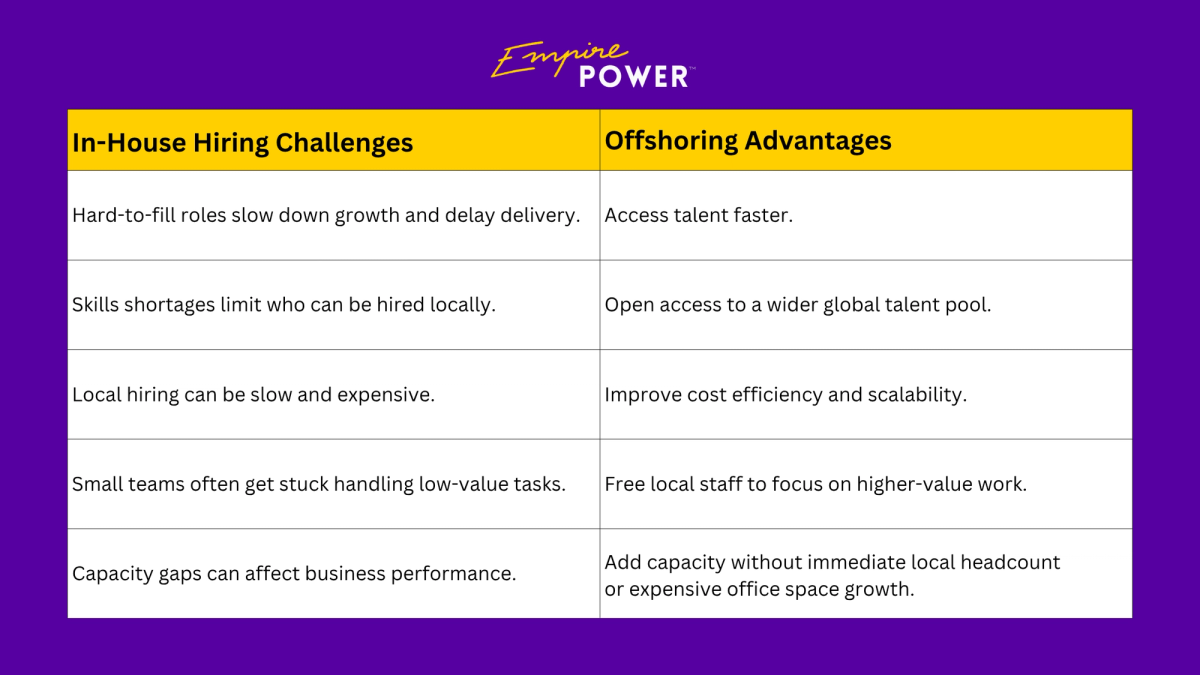
Australian businesses are offshoring because they are struggling to fill roles that their business needs by hiring locally. There are not enough skilled workers to meet the current demand.
According to the Hays 2025 Skills Report, 85% of organisations across Australia and New Zealand are actively battling critical skills gaps, with 91% of hiring managers citing skills scarcity as their primary operational challenge.
Here’s a side-by-side comparison of why Australian businesses prefer offshoring for growth:
How to Build and Manage High-Performing Offshore Teams
While it may initially appear challenging, learning how to build and manage an offshore team is not as complex as many business owners believe. You need to treat them like a core part of your business, not a separate support function.
Here is your step-by-step playbook to make it happen:
Step 1: Align Roles with Your Long-Term Strategy
Start by deciding which roles to delegate, which tasks belong to your local in-house staff, and what operational success will look like over the next 6 to 12 months. This matters because a successful outsourcing strategy relies on identifying roles that contribute to your business growth.
These are the highest-leverage roles worth delegating:
- Customer Support and Customer Service Representatives: Providing multi-channel email, chat, or phone coverage aligned directly to Australian business hours.
- Human Resources and Recruitment: Sourcing talent pools, screening resumes, and coordinating initial interviews.
- Accounting and Bookkeeping: Handling daily accounts payable, receivable, and payroll processing.
- Digital Marketing Specialists: Including SEO managers, content writers, and social media coordinators.
- Software Developers: Executing front-end, back-end, and technical app maintenance.
- Virtual Assistants: Managing executive calendars, travel booking, and routine administrative data entry.
Step 2: Hire the Right Talent with Empire Outsourced
Hiring through an outsourcing provider like Empire Outsourced can make offshore hiring simpler, faster, and more compliant. This partnership provides three distinct benefits for your business:
1. Rigorous talent vetting: Manage the sourcing and screening process to match your business with suitable remote talent.
2. Recruitment,Payroll, and HR support : Handle recruitment, payroll, HR support, and ongoing management.
3. Culture-fit onboarding: The recruitment and onboarding framework can match candidates with your business requirements and culture.
Step 3: Onboard and Integrate Your Team into Your Company Culture
Onboarding and integrating your team from day one ensures your business standards, core values, brand tone, and expectations will be met. To seamlessly do this, use these onboarding tech stacks:
- Slack and Microsoft Teams: Use to set up dedicated channels for daily updates, cultural banter, and real-time team collaboration.
- Notion: Use to document workflows, brand guidelines, and standard operating procedures (SOPs).
- Loom: Use for asynchronous video walkthroughs.
- Trainual: Use to create interactive, trackable onboarding tracks for new hires.
Step 4: Establish Asynchronous Communication Protocols
Asynchronous communication is essential when your offshore team works across time zones. The goal is not to reduce team interaction, but to create a structured communication rhythm.
Here’s how it works:
- Instant Messaging: Reserved for urgent, time-sensitive queries, daily check-ins, and casual team culture interactions.
- Email: Dedicated to formal client updates, major company announcements, and external documentation sharing.
- Synchronous Meetings: Scheduled sparingly, primarily for strategic alignment, complex brainstorming, or essential team-building sessions.
Step 5: Track Outcome-Based Performance Metrics
Outcome-based performance metrics are the best way to manage your team. It makes it easier to spot training gaps early. If performance drops, you can see whether the issue is process, skills, or communication.
To track performance and metrics without micromanaging, use these platforms:
- Hubstaff and Time Doctort Use to track hours spent on specific tasks and monitor overall output.
- ClickUp and Asana: Use to monitor task completion rates, track deadlines, and see who is delivering work on time.
Frequently Asked Questions
What is the difference between offshore and onshore teams?
Offshore means your team is based in another country, while onshore means the work is done locally in Australia. In practical terms, onshore teams usually offer closer time zone alignment and face-to-face collaboration, while offshore teams can offer greater flexibility, broader talent access, and stronger cost efficiency.
Does offshore outsourcing protect my business's intellectual property?
Yes, it can. The main risk is not offshore outsourcing itself, but poor governance around it. If you limit access, document responsibilities, and work with a provider that follows proper security and legal processes, you can reduce risk significantly.
Can I Offshore as a Small Business Owner?
Yes, absolutely. Offshore outsourcing is often a smart option for small business owners who need extra support without committing to the cost of full-time local hires.
See What an Outsourcing Company Can Do for You
If you’re ready to scale faster, run smarter, and delegate with a partner you can trust, Empire Outsourced can help you build and manage a high-performing team for long-term growth.
Book a free consultation and discover how we can support your business growth.