
45% of Aussie SMBs Have Been Hit by Cyber Incidents: How to Keep Your Data Safe When Outsourcing

Outsourcing for many small and medium-sized businesses (SMBs) isn’t a cyber security liability. But the risk of exposure can increase if access controls, contracts, monitoring, staff training, and Australian privacy obligations are poorly managed.
ESET’s 2026 SMB Cyber Readiness Index found that 45% of surveyed businesses experienced a cyber security incident during the previous year, while phishing was the most commonly reported cause.
Key Takeaways
- ISO 27001 compliance ensures providers follow audited, standardised information security management systems.
- Restrict data access using RBAC, MFA, and Virtual Desktops.
- Australian Privacy Principle 8 (APP 8) mandates that local businesses retain accountability for overseas data handling.
Why Are Small Australian Businesses a Prime Target?
Cybercriminals frequently target small businesses because they offer paths of least resistance. Unlike large corporations equipped with dedicated Security Operations Centres (SOCs), small businesses often operate with limited IT budgets, outdated software, or unmonitored endpoints.
Here are some of the reasons Australian SMBs are targeted primarily:
- Resource Deficits: Limited capacity to implement continuous network monitoring or threat detection.
- Access Points to Larger Supply Chains: Threat actors target SMBs to gain secondary access to larger enterprise clients.
- Phishing and Credentials Defenses: Staff in smaller teams may lack regular security awareness training, making them susceptible to social engineering attacks.
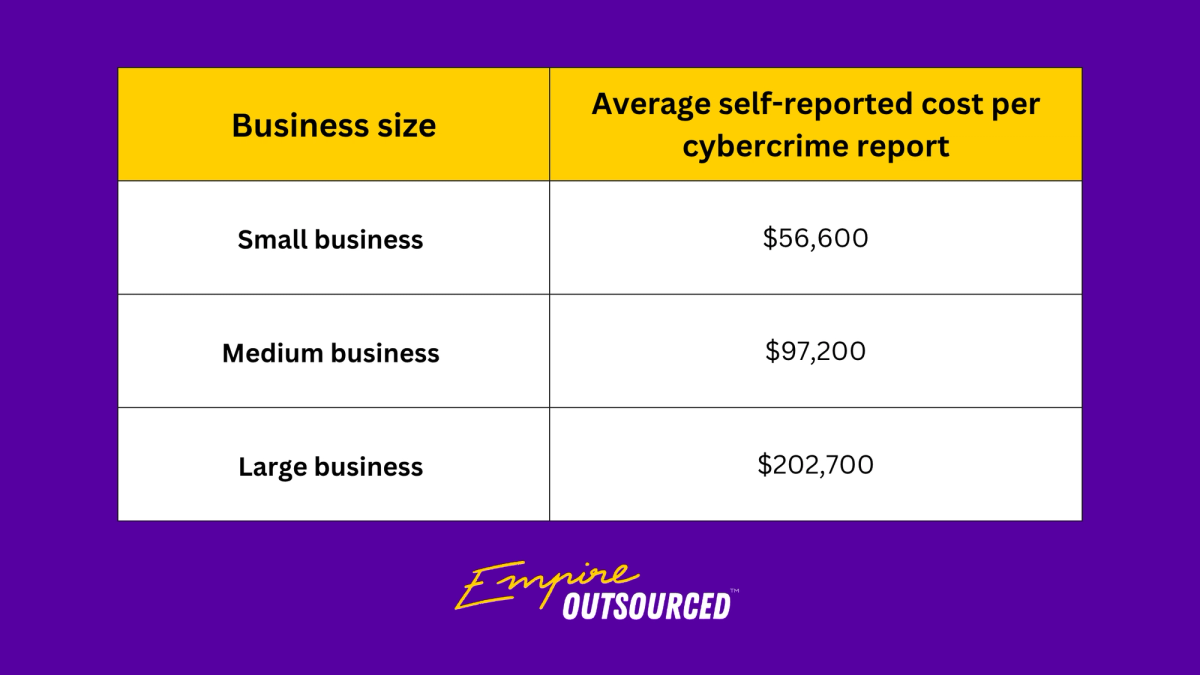
The Average Losses Incurred by SMBs as per the ACSC Annual Cyber Threat Report 2024–25
Average self-reported losses for Australian businesses increase significantly by company size, according to the official Australian Cyber Security Centre (ACSC) threat data:
How to Ensure Your Data Is Safe When Outsourcing: 5 Best Practices
1. Partner with ISO 27001-Compliant Outsourcing Providers
An ISO 27001-compliant provider has an information-security management system designed to identify, manage, and reduce information-security risks. Certification does not eliminate every risk, but it signals that the provider has formal policies, controls, audits, and improvement processes rather than relying on ad hoc security practices.
- Global Standard: Confirms that the provider maintains a robust Information Security Management System (ISMS) based on risk assessment and strict security controls.
- Standardised Controls: Relies on verifiable, documented policies and internal reviews rather than verbal safety assurances
- Reduced Risk: Lowers legal exposure and simplifies vendor due diligence for regulated fields like finance and healthcare.
Empire Outsourced partners operate at one of the highest security levels. Our partners are ISO 27001- compliant, which means every single process and policy is strictly registered and audited.
2. Implement Role-Based Access Controls and MFA
Implementing Role-Based Access Control (RBAC) and Multi-Factor Authentication (MFA) during outsourcing secures external vendors by limiting system permissions to specific job duties and verifying user identities beyond standard passwords.
3. Use Secure Virtual Desktop Infrastructure
Avoid allowing remote team members or virtual assistants to save company data directly onto local personal devices. Deploy a secure Virtual Desktop Infrastructure (VDI) (e.g., Microsoft Azure Virtual Desktop or Citrix).
- Data remains within your encrypted cloud tenant.
- Clipboard sharing, local downloads, and USB file transfers can be centrally restricted.
4. Enforce Strict Non-Disclosure and Data Protection Agreements
Your outsourcing agreement should clearly define what the provider may access, how long they may retain it, and what happens if something goes wrong.
At minimum, include:
- Execute comprehensive Non-Disclosure Agreements (NDAs) and binding Data Protection Agreements (DPAs).
- Ensure agreements specify data ownership, explicit processing limits, and mandatory breach notification timelines compliant with the Privacy Act 1988 and the Notifiable Data Breaches (NDB) scheme.
5. Conduct Regular Security Awareness Training for Virtual Assistants
Human error remains a primary vector for cyber incidents. Extend security protocols to your outsourced workforce.
- Provide ongoing training in recognising phishing attempts, social engineering, and secure password management.
- Conduct regular simulated phishing exercises to verify adherence to protocols.
Frequently Asked Questions
How do I ensure an offshore team complies with Australian data privacy laws?
You must retain full legal accountability and take reasonable steps under Australian Privacy Principle 8 (APP 8) of the Privacy Act 1988 to ensure overseas recipients handle personal information to Australian standards.
Does outsourcing data-handling tasks increase my business’s breach risk?
No, outsourcing decreases breach risk if you partner with a provider whose security posture exceeds your internal capabilities. Risk increases only when businesses engage unvetted, non-compliant third parties without enforcing technical controls like MFA, role-based access, and restricted VDI environments.
What software controls should I require for virtual assistants?
Require secure cloud infrastructure, role-based access limits, and automated tracking tools to maintain oversight and data protection when working with virtual assistants.
Avoid Cyber Threats and Delegate with a Partner You Can Trust
As cyberattacks continue to escalate, outsourcing itself isn't the risk. Unmanaged outsourcing is. Businesses that outsource securely build systems that don’t depend on trust alone.
Empire Outsourced presents EmpireOne members with candidates who fit their culture and requirements, so they can onboard with confidence while keeping their data secure. Our remote team members work on company-managed devices equipped with end-to-end Microsoft encryption and strict access controls.
See how we can support your business growth. Fill out the consultation request or book a free consultation to speak with our concierge today about your virtual assistant needs!
Related Reading: